
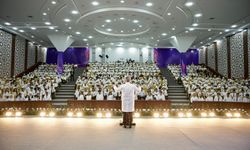
Imagine a medical school today.
Textbooks, clinical training, diagnosis of disease, surgical knowledge, and rules governing how medicine should be practiced...
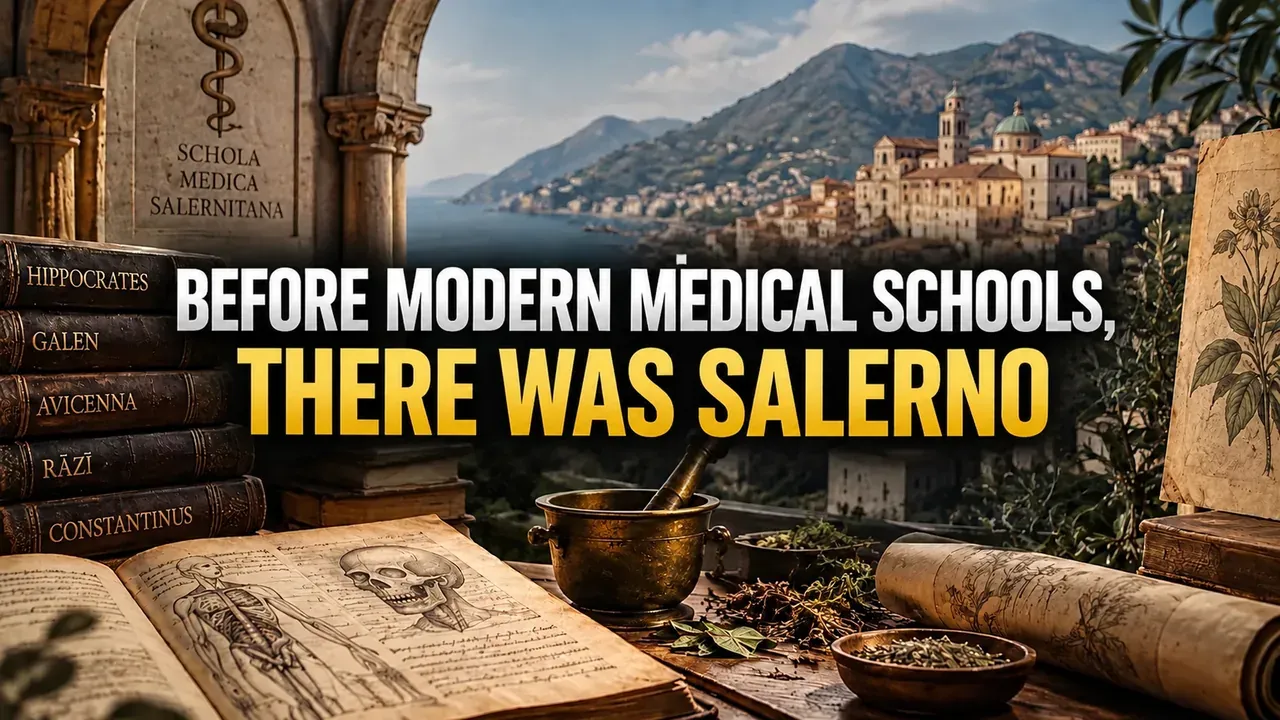
One of the important milestones in the institutional history of these traditions in Europe emerged around a thousand years ago in the southern Italian city of Salerno.
Before universities in the modern sense became widespread across Europe, Salerno had developed into an important center where medical knowledge from different sources was taught.
The tradition now known as the Schola Medica Salernitana, or Salerno Medical School, became increasingly visible from the 10th century onward and rose to a significant position in European medical history during the 11th and 12th centuries.
Salerno’s importance was not based solely on training physicians.
What made it particularly remarkable was its role in bringing together medical knowledge produced in different cultures within the same geographical and intellectual environment.
When was the Salerno Medical School founded?
The answer is not as simple as it may seem.
Some sources trace medical teaching in Salerno back to the 9th century or even earlier. However, it would be misleading to think of the school as a university founded on a single, clearly documented date in the modern sense.
Medical teaching in Salerno developed gradually over time.
The center’s reputation began to grow particularly in the 10th century, and by the 11th and 12th centuries it had become one of Europe’s important medical centers.
For this reason, rather than assigning Salerno a precise “founding day,” it is more accurate to view it as a medical teaching tradition that evolved over several centuries.
Is the story that four physicians founded the school true?
One of the best-known legends in the history of the Salerno school concerns its founding.
According to the story, the school was established by four physicians:
a Latin,
a Greek,
a Jewish physician,
and an Arab physician.
These four figures were said to have brought together different medical traditions and laid the foundations of Salerno.
However, this account cannot be regarded as a documented historical event.
Modern historical scholarship treats it as a founding legend.
Even so, the idea represented by the legend reflects an important feature of Salerno’s actual history:
Salernitan medicine did indeed develop in an environment where knowledge from different cultural traditions came together.
Why did Salerno become such an important center?
Salerno’s geographical position played an important role.
Southern Italy was in contact with different regions of the Mediterranean world.
The Latin medical tradition of Western Europe encountered Greek and Byzantine medical heritage there, while works translated from Arabic medical literature also entered circulation in Western Europe.
During the 11th and 12th centuries, texts derived from Greek, Latin and Arabic traditions, together with local medical practice, came together in different ways in and around Salerno.
This helped make Salerno not only a center of treatment but also an important place for the transmission and teaching of medical knowledge.
Constantine the African and the great translation movement
One of the most important figures associated with Salerno’s history is Constantinus Africanus, or Constantine the African.
Active in southern Italy in the 11th century, Constantine is generally understood to have begun his translation work in Salerno and later continued it at the monastery of Monte Cassino.
He played a major role in transmitting Arabic medical literature into Latin, thereby expanding access in Latin Europe to important medical writings of the period.
One of his most important works was the Pantegni, based on the extensive medical writings of the Persian physician Ali ibn Abbas al-Majusi.
The Pantegni became one of the foundational medical texts of medieval Latin medicine.
There is, however, an important historical distinction to make:
Claims that Constantine formally taught at Salerno or was directly part of the school’s teaching staff are not firmly established.
His most clearly documented influence lies in the circulation of the works he translated and adapted, first in the Salernitan environment and later throughout European medical education.
Why were Arabic medical texts so important?
Medical literature in the medieval Islamic world was highly developed.
Large parts of the ancient Greek medical tradition had been translated into Arabic, preserved, interpreted, and further developed by physicians through new observations and medical writing.
The works of al-Razi, Ali ibn Abbas al-Majusi, Ibn al-Jazzar, and many other physicians formed part of a substantial body of medical knowledge.
Through the translation activities associated with Constantine the African, important portions of this literature became available to the Latin world.
The Pantegni in particular became a major reference work on anatomy, causes of disease, and approaches to treatment.
As a result, medical teaching around Salerno was not limited to older Latin texts but gained access to a broader pool of knowledge shaped by different scientific traditions across the Mediterranean.
What did medical students study in the Middle Ages?
One of Salerno’s important contributions to later European medical education was its role in the systematization of medical knowledge around specific texts and traditions of interpretation.
In this context, the medical text collection known as the Articella became historically important.
The Articella was long strongly associated with medical teaching in Salerno.
However, historians continue to debate where the collection was actually formed; alongside the traditional Salernitan attribution, a Parisian origin has also been proposed.
For that reason, it would be inaccurate to describe the Articella definitively as “a textbook created in Salerno.”
There is, however, broad agreement that the Articella was highly influential in medieval European medical education.
The collection included Latin texts associated with the Hippocratic and Galenic traditions, as well as writings linked to Hunayn ibn Ishaq and other medical authors.
The systematization of medical teaching in the Salernitan environment around texts, commentary, and practical knowledge contributed to the later development of university-based medical education in Europe.
Women were present in Salerno’s medical world
One of the most striking features of Salerno is the visibility of women in its medical environment.
Historical sources refer to female practitioners known as mulieres Salernitanae, meaning “women of Salerno.”
One of the best-known figures associated with this tradition is Trota.
However, the subject of “Trotula” was presented too simplistically in popular historical accounts for many years.
Modern scholarship has shown that “Trotula” was not the name of a single female author, but rather the title associated with a collection of three separate texts on women’s health.
It would therefore be inaccurate to claim that all of these texts were written by one female physician.
At the same time, strong historical scholarship links at least one of the texts in the collection to a female practitioner from Salerno named Trota.
This distinction matters.
It preserves the genuine historical importance of women in Salernitan medicine without assigning excessive certainty to a later, simplified image of a single legendary “Trotula.”
The presence of women in Salerno’s medical world shows that women’s role in the production and practice of medical knowledge in medieval Europe was more complex than is often assumed.
The health guide associated with the name of Salerno
One of the most famous health texts associated with Salerno is the Regimen Sanitatis Salernitanum.
However, it has not been conclusively demonstrated that the work was actually written at the Salerno Medical School.
The anonymous Latin poem, which was expanded in different periods, contained a range of recommendations aimed at preserving health.
Diet,
sleep,
exercise,
emotions,
and daily routines
were among the topics given significant attention.
It would therefore be misleading to treat the work as a modern-style health guide written by a single author at a clearly defined moment.
Nevertheless, the widespread circulation of the Regimen Sanitatis Salernitanum across Europe is notable because it shows how old medical ideas about preventive health and lifestyle management really are.
Surgery was also important in the Salernitan tradition
The influence of the Salernitan tradition was not limited to internal medicine or diet.
The 12th-century surgeon Roger Frugardi is also known in sources as Rogerius Salernitanus.
The Practica Chirurgiae, also known as the Chirurgia Rogerii, is associated with him and became one of the important surgical texts of medieval Europe.
The work organized surgical problems according to different parts of the body and described possible treatments.
It became an important example of how surgical knowledge could be transmitted in a systematic written form and influenced later surgical literature.
Was Salerno a modern medical school?
Not exactly.
It would be historically inaccurate to portray Salerno as an institution identical to a modern university.
There was no faculty administration, modern diploma system, laboratory infrastructure, medical specialization structure, or scientific research framework comparable to those of today.
Salerno’s importance lay elsewhere.
By teaching medical knowledge in a more systematic way, bringing together texts from different traditions, and developing a recognizable culture of medical instruction, it became an important stage in the development of later European university medicine.
Medical texts used and circulated in Salerno later influenced university medicine in centers such as Bologna, Montpellier, Paris, and elsewhere in Europe.
Rules also emerged for becoming a physician
The 13th century marked an important turning point in Salerno’s history.
During the reign of Holy Roman Emperor Frederick II, medical education and the right to practice medicine in southern Italy became subjects of state regulation.
These measures are regarded as an important stage in European medical history because they linked medical education more explicitly to standards and to the assessment of a physician’s qualifications.
Medicine thus became more clearly associated with formal education and demonstrated competence.
However, because historical sources vary regarding exact training periods, examination structures, and anatomical requirements, it would be misleading to present these details as a single, universally fixed model.
From a medieval school to modern medical education
What makes the history of the Salerno Medical School important is not that modern medicine had somehow already been discovered a thousand years ago.
Physicians in Salerno still worked within the limited anatomical knowledge of their time, humoral theories, and many medical ideas that have no scientific validity today.
Its importance lies elsewhere:
in taking knowledge from different cultures,
translating it,
organizing it,
teaching it,
and passing it on to new generations of physicians.
Greek and Latin medical heritage, Arabic medical literature, and different intellectual traditions of the Mediterranean met in and around Salerno.
The visibility of women in medicine, the development of surgical texts, the circulation of health-related writings, and the gradual systematization of medical education all contributed to the center’s historical significance.
Modern medical schools are not direct copies of Salerno.
But the processes that took place there around a thousand years ago represented an important stage in the transformation of medicine in Europe into a more systematically taught academic discipline.
For that reason, Salerno’s legacy is not simply the story of an old medical school.
It is also the story of how medical knowledge grew by moving across cultures.
SOURCES
U.S. National Library of Medicine — Medieval Manuscripts: The School of Salerno
U.S. National Library of Medicine — An Odyssey of Knowledge: From Translation to Teaching
Neurosurgery — The Schola Medica Salernitana: The Forerunner of the Modern University Medical Schools
Treccani — La scuola di Salerno e l'Articella
Oxford Academic — Constantine the African and Medieval Medical Teaching
Medicina nei Secoli — Constantine the African and Salernitan Pharmacology
University of Edinburgh Collections — Regimen Sanitatis Salernitanum
Greek, Latin and Arabic Medical Knowledge Met in One City: How Did Salerno Become a Medical Center?
Before modern universities became widespread in Europe, Salerno in southern Italy had emerged as one of the most important centers of medical teaching in the Middle Ages. Greek and Latin medical traditions, knowledge transmitted through Arabic medical texts, and local practices came together in the same intellectual environment.



Editör Hakkında
Bunlar da ilginizi çekebilir


Yorumlar