Ahmet Balcı
Researcher and Author
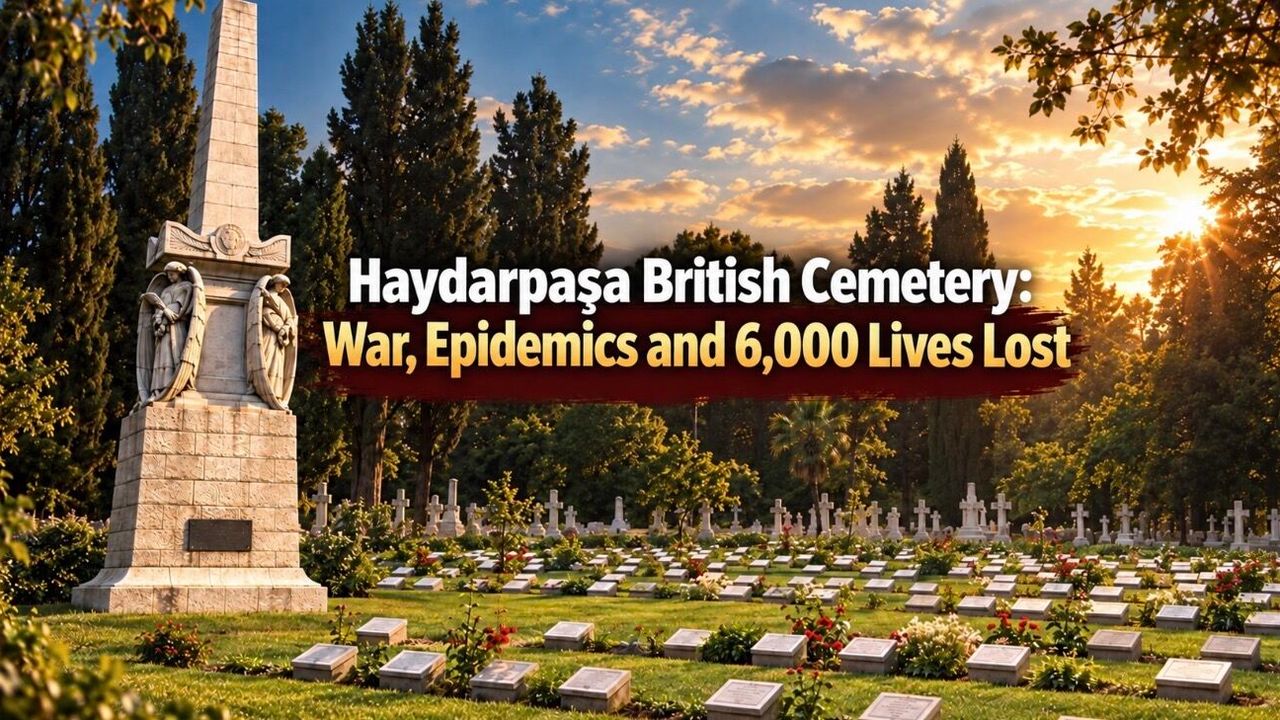
Hidden among the trees behind Istanbul’s Haydarpaşa railway district lies one of the city’s least-known historic sites. At first glance, Haydarpaşa British Cemetery resembles a quiet landscaped park. Beneath its lawns, however, lies a history stretching from war and epidemic disease to modern nursing and international diplomacy.
This is not simply a burial ground for British soldiers. It is a shared place of memory for thousands who died during the Crimean War, Ottoman officers of foreign origin, British diplomats, Levantine families and Commonwealth servicemen from both world wars.
DISEASE KILLED MORE THAN BULLETS
The cemetery’s story begins with the Crimean War of 1853–1856, when the Ottoman Empire, Britain and France fought together against Russia.
Thousands of sick and wounded British soldiers were transported from Crimea to Istanbul. Selimiye Barracks, Haydarpaşa Military Hospital, Kuleli and several buildings in Tarabya were converted into military hospitals.
The facilities soon became overwhelmed. Shortages of clean water, proper sanitation, ventilation, beds and medical supplies created a major health disaster. Many soldiers died not from battlefield wounds but from cholera, dysentery, typhus and infections spreading through overcrowded wards.
As the number of deaths rose, the slopes of Haydarpaşa were selected as a burial ground because of their proximity to the military hospitals.
The Commonwealth War Graves Commission states that the cemetery contains around 6,000 Crimean War burials. Most of those graves are unmarked, however, and the exact number remains uncertain because many soldiers were placed in collective burial areas.
LAND GRANTED BY SULTAN ABDULMEJID
The cemetery land was granted to Britain by Sultan Abdulmejid I in 1855. The first burials were made on two separate plots, which were later connected through an additional land grant in 1867.
Covering approximately 30 dönüms, the site gradually acquired the appearance of a Victorian garden cemetery, with tree-lined paths, lawns, monuments and sculptural gravestones.
From 1867 onwards, it was also opened to the burial of British civilians living in Istanbul.
FLORENCE NIGHTINGALE’S ÜSKÜDAR YEARS
Florence Nightingale is closely associated with the cemetery, although she is not buried there.
She arrived in Üsküdar on 5 November 1854 with a group of 38 nurses. At Selimiye Barracks, she confronted overcrowded wards, dirty laundry, inadequate sanitation and the rapid spread of infectious diseases.
Nightingale worked to improve cleanliness, organise nursing services and separate infectious patients. Her nightly rounds through the wards with a lamp earned her the enduring title “The Lady with the Lamp.”
The fall in mortality at Scutari should not be attributed to Nightingale alone. The work of the British Sanitary Commission, which repaired drains and improved ventilation and water systems, also played a decisive role.
In 1954, a bronze plaque honouring Nightingale’s work was placed on the Crimean War Memorial inside the cemetery.

QUEEN VICTORIA’S 28-METRE MONUMENT
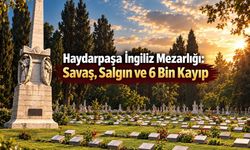
The cemetery’s most recognisable structure is the approximately 28-metre-high Crimean War Memorial, erected in 1857 in the name of Queen Victoria and the British people.
Designed by French-born sculptor Baron Carlo Marochetti in the Neo-Egyptian style, the monument features an angel at each of its four corners. It is therefore also known as the “Monument of the Angels.”
The angels hold laurel wreaths and quills, symbolising remembrance, sacrifice and the recording of the dead in history. Inscriptions on the monument appear in English, French, Italian and Ottoman Turkish written in Arabic script.
A model of the memorial was displayed at the Crystal Palace Peace Fête in London in May 1856, marking the end of the Crimean War. The completed monument was erected in Haydarpaşa the following year.
SEVENTEEN GRAVES DAMAGED IN 1923
The cemetery also became the focus of an unusual diplomatic dispute during the founding days of the Republic of Türkiye.
On 5 and 6 October 1923, as crowds celebrated the entry of Turkish troops into Istanbul, a group of porters entered the cemetery to collect laurel branches for the festivities. Seventeen graves were partially damaged.
Britain responded strongly, while the Turkish government stressed that the incident was neither planned nor officially sanctioned. Efforts were made to repair the damage and prevent the dispute from escalating.
Archival research shows that the episode reflected the fragile state of Turkish–British relations immediately after the Treaty of Lausanne.
TRACES OF TWO WORLD WARS
Haydarpaşa continued to receive burials long after the Crimean War.
During the First World War, Commonwealth prisoners of war who died in Ottoman territory were buried there. Further burials were made during the Allied occupation of Istanbul between 1918 and 1923.
Official records list 407 Commonwealth burials from the First World War, 60 of them unidentified. The cemetery also contains 39 burials from the Second World War, including 14 unidentified servicemen.
Türkiye remained neutral for most of the Second World War. Some of those buried at Haydarpaşa had been captured during operations in the Aegean, died while attempting to escape detention or were found on the Turkish coast.
A MEMORIAL TO 122 INDIAN SOLDIERS
One of the cemetery’s most distinctive sections commemorates members of the Indian Army.
The Haydar Pasha Cremation Memorial honours 122 Hindu and Sikh soldiers who died in 1919 and 1920. They had originally been commemorated at the Mashlak and Osmaniye Indian cemeteries.
When those sites could no longer be maintained, soil containing their cremated remains was transferred to Haydarpaşa in 1961. The remains of Muslim soldiers buried at the same locations were reinterred at the cemetery.
As a result, Islamic gravestones bearing the word “Bismillah” can be seen alongside crosses and other Christian memorials.
OTTOMAN PASHAS AND DIPLOMATS
The cemetery is also the resting place of foreign-born officers who served the Ottoman Empire, as well as diplomats and prominent members of Istanbul’s Levantine community.
Augustus Charles Hobart-Hampden, known as Hobart Pasha, entered Ottoman naval service after serving in the British Navy. He rose to the rank of marshal and, following his death in Milan in 1886, was brought to Istanbul and buried at Haydarpaşa in accordance with his wishes.
General Richard Guyon, a British-born commander associated with the Hungarian Revolution of 1848 who later entered Ottoman service, is also buried there.
The cemetery’s largest mausoleum belongs to Sir Nicholas O’Conor, the British ambassador to the Ottoman Empire from 1898 until his death in 1908.
The civilian section also contains the graves of Byzantine historian and Robert College professor Alexander van Millingen, along with members of well-known Levantine families including the Whittalls, La Fontaines and van Millingens.
A TOMBSTONE FROM THE 1590s
One of the oldest historical objects preserved at the cemetery is the tombstone of Edward Barton, Queen Elizabeth I’s ambassador to the Ottoman court.
Barton accompanied the Ottoman army during the Eger campaign and later died on Heybeliada after attempting to escape an epidemic in Istanbul. He was initially buried in the courtyard of a church on the island.
His Latin-inscribed tombstone disappeared after being moved several times but was rediscovered in the 1990s and transferred to Haydarpaşa for protection.
It should not be assumed that Barton’s remains were also moved. The available historical evidence clearly documents the transfer of the tombstone, but not necessarily his body.
GRAVESTONES SHIPPED FROM BRITAIN
Small makers’ marks discovered at the bases of several monuments have revealed another remarkable part of the cemetery’s history.
Many of the sculptural gravestones in the civilian section were commissioned from workshops in Britain and shipped to Istanbul. Others were produced by local stone carvers.
The stones display influences from Ancient Greek, Roman, Gothic, Celtic and Neo-Egyptian design, giving parts of the cemetery the appearance of an open-air sculpture gallery.
The landscape itself also reflects a cultural exchange. Victorian garden cemeteries were partly influenced by Western travellers’ descriptions of Istanbul’s spacious, cypress-filled Ottoman burial grounds. At Haydarpaşa, Victorian funerary art and Ottoman landscape traditions came together once again.
ISTANBUL’S SILENT HISTORICAL ARCHIVE
Haydarpaşa British Cemetery was born not from a military victory but from a public-health catastrophe. Thousands of soldiers brought from Crimea died from epidemics and inadequate hospital conditions rather than enemy fire.
Over time, they were joined by diplomats, Ottoman officers, educators, Levantine families, prisoners of war and Indian soldiers of different faiths.
Today, the four stone angels rising above Haydarpaşa commemorate more than the dead of one war. They stand as witnesses to the Ottoman–British alliance, the development of modern nursing, Istanbul’s cosmopolitan past and the human cost of conflict.
SOURCES
1. Commonwealth War Graves Commission — Haidar Pasha Cemetery records.
2. Mustafa Kaan Sağ and Mustafa Çağhan Keskin — The Gravestone Sculptors and the Maker’s Marks at the Haydarpaşa British Cemetery.
3. Feyza Kurnaz Şahin — The Issue of the Damage to Haydarpaşa British Cemetery After the Treaty of Lausanne.