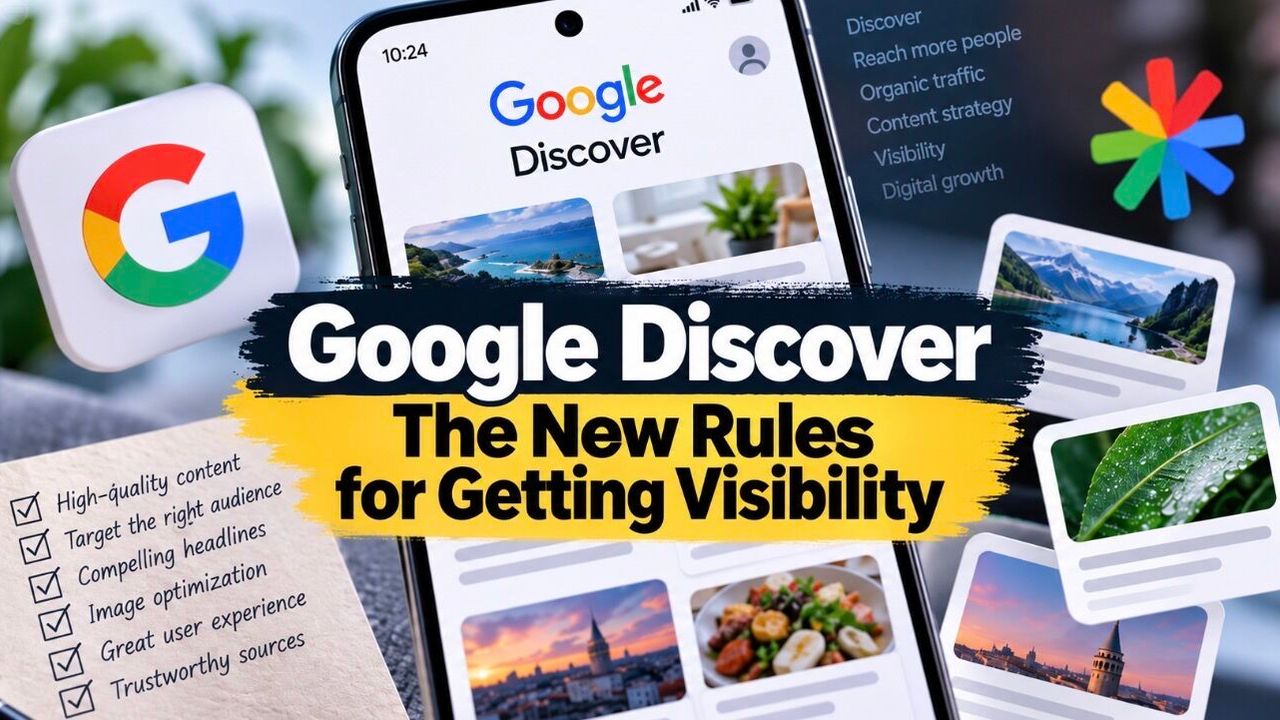
Google Discover has become an important traffic source for publishers, but it works very differently from traditional Google Search.
In most cases, users do not type a query before seeing Discover content. Instead, Google recommends articles, guides, videos and other content based on users’ interests and activity.
That difference changes the publishing strategy completely.
Success in Discover is not only about keywords. Topic relevance, originality, headline quality, image selection, site trust and mobile experience all play a role.
Do you need to apply for Google Discover?
No.
There is no separate application form for Google Discover, and publishers do not need to use a special Discover tag.
Pages that are indexed by Google and comply with Discover content policies are automatically eligible to appear in Discover.
But there is an important distinction:
Being eligible for Discover does not mean that a page will necessarily be shown there.
Google’s systems determine which content may be relevant to individual users.
In Discover, interest matters more than keywords
Traditional SEO often starts with one question:
“What are people searching for?”
Discover adds another:
“What might people become interested in next?”
That is because Discover is primarily interest-driven rather than query-driven.
A new medical study, a major scientific development, a regulatory decision or an emerging public issue can begin appearing in Discover before large numbers of people actively search for it.
For publishers, this means that search volume alone is not enough.
Editorial teams also need to follow trends, scientific developments, seasonal interest, audience behavior and changing public curiosity.
Google increasingly emphasizes original value
One of the biggest problems in online publishing is that the same information is often repeated across hundreds of websites.
This is particularly common in news publishing, where press releases may be rewritten with only minor wording changes.
For Discover, the more important question is whether the article adds genuine value.
Editors should ask:
Why does this development matter?
Who does it affect?
What has changed?
What was the situation before?
What do the data show?
What do experts say?
What will the reader learn here that they cannot easily find elsewhere?
Answering these questions can turn a routine rewrite into a genuinely useful editorial product.
Headlines should be strong, but not misleading
Discover is a fast-moving environment.
Users often decide within seconds whether they want to open a content card.
That makes the headline extremely important.
But a strong headline is not the same as clickbait.
Phrases such as:
“Doctors Are Shocked”
“No One Knows This”
“This Food Stops Disease”
may attract attention, but they can damage trust when they exaggerate or misrepresent the content.
Google advises publishers to avoid misleading or sensational headlines and previews that are designed mainly to manipulate engagement.
The goal should be simple:
Create curiosity without distorting the truth.
Strengthen the headline without making claims that the article cannot support.
Why the 1,200-pixel image rule matters
Discover is highly visual.
Google recommends using large, high-quality and relevant images.
Current technical recommendations include:
Images that are at least 1,200 pixels wide,
high-resolution visuals,
preferably a 16:9 landscape composition,
the use of max-image-preview:large,
and defining the preferred image through og:image or appropriate structured data.
But resolution alone is not enough.
The image must still work when it appears as a small card on a mobile screen.
The main subject should not disappear.
Important faces, objects or visual information should not be placed too close to the edges.
The image should clearly represent the article.
Generic site logos or weakly related stock images should not be used as the main visual.
Should you put a lot of text on Discover images?
Usually not.
One of the most common mistakes is turning the entire article headline into text on the image.
Google recommends avoiding images overloaded with text.
That does not mean that all text is forbidden.
A short, readable and editorially meaningful headline can work well.
But if the text becomes unreadable when the image is reduced to a small mobile card, or if it takes over the entire visual, the design has failed.
A better principle is:
Let the image explain the topic.
Let the headline add meaning.
Can old content appear in Discover?
Yes.
Discover is not limited to breaking news.
Older content can reappear if it remains useful and relevant to a user’s interests.
This creates an important opportunity for evergreen publishing.
For health publishers, evergreen content may include:
disease guides,
blood test explainers,
nutrition articles,
treatment and medication information,
doctor biographies,
medical history features,
and frequently asked health questions.
These pages may gain Discover visibility long after their original publication date.
A strong strategy therefore combines timely news with a valuable evergreen archive.
Changing the date alone is not a real update
Some publishers try to make old content look fresh by changing only the publication date.
That is not the same as updating the article.
A meaningful update should add something new.
For example:
a new study,
updated regulation,
new statistics,
new treatment guidance,
fresh expert commentary,
or important new context.
The important factor is not the date on the page.
It is whether the content itself has actually changed.
Trust is especially important for health content
Discover can be a major opportunity for health publishers.
But health is also an area where inaccurate information can cause serious harm.
For that reason, health content should clearly present:
the author’s identity,
relevant expertise,
reliable sources,
publication date,
update date,
and the strength of the evidence behind major claims.
If a study shows only an association, it should not be presented as proof of cause and effect.
Animal research should not be framed as a proven human treatment.
Early findings should not be described as definitive conclusions.
The desire to create a stronger Discover headline should never override scientific accuracy.
Is AI-generated content a problem?
Not automatically.
The problem is not the use of artificial intelligence itself.
The real issue is mass-producing low-value pages that add little or nothing for the reader.
AI can be useful for:
speeding up research,
organizing information,
comparing sources,
improving article structure,
and generating headline options.
But producing hundreds of nearly identical pages purely to capture search or Discover traffic is not a sustainable publishing strategy.
AI should support the editorial process, not replace editorial judgment.
Discover is also entering the generative AI era
Google Discover is no longer limited to traditional content cards.
Google has been expanding generative AI features across its discovery and search experiences, and publishers can now monitor some of that visibility through Search Console reporting.
This matters because Google visibility is no longer limited to classic search results or standard Discover cards.
A publisher’s content may also appear as a source within AI-assisted discovery experiences.
That creates a new layer of visibility for publishers.
How can Discover performance be measured?
Google Search Console is the most important tool.
When a site receives enough Discover impressions, a Discover Performance report may become available.
Publishers can use it to analyze:
impressions,
clicks,
click-through rate,
top-performing pages,
countries,
and changes over time.
But the total number of visits should not be the only metric.
Editors should also ask:
Which topics appear in Discover most often?
Which headlines generate stronger click-through rates?
Which visual formats perform best?
How long does traffic last after publication?
Do evergreen articles return to Discover later?
Which categories repeatedly gain visibility?
Over time, this analysis can help each publisher develop its own Discover strategy.
Why can Discover traffic suddenly fall?
Discover traffic can be more volatile than traditional search traffic.
A site may receive very high traffic one week and significantly less the next.
That does not always mean there has been a penalty.
Changes may be caused by:
shifts in user interests,
changes in trending topics,
changes in the kinds of content shown in Discover,
or updates to Google’s systems.
For that reason, Discover should not be treated as the only traffic source.
Organic Search, Google News, direct traffic, social media and other distribution channels should all be part of a wider publishing strategy.
A Discover publishing checklist
Before publishing an article, editors should ask:
Is this topic genuinely interesting to our audience?
Does the article add something original?
Does the headline accurately represent the content?
Does it create curiosity without misleading the reader?
Is the main image at least 1,200 pixels wide?
Does the image still make sense when viewed as a small mobile card?
Is the main image correctly defined?
Do the author and sources inspire trust?
Is the page easy to read on mobile devices?
Will the reader learn something meaningful after finishing the article?
If the answer to most of these questions is no, changing the SEO title alone is unlikely to solve the problem.
What is the real formula for Google Discover?
There is no guaranteed method for entering Google Discover.

But the principles that can improve visibility are becoming increasingly clear:
The right topic.
The right timing.
Original information.
Trustworthy content.
A strong but accurate headline.
High-quality visuals.
A good mobile experience.
Real value for the reader.
The future of Discover cannot be explained by SEO techniques alone.
It sits at the intersection of journalism, audience behavior, visual storytelling, technical SEO and editorial strategy.
Trying to exploit the algorithm is less useful than creating content that people genuinely want to read.
The most important question remains simple:
Is this content good enough that Google would have a reason to recommend it to someone?