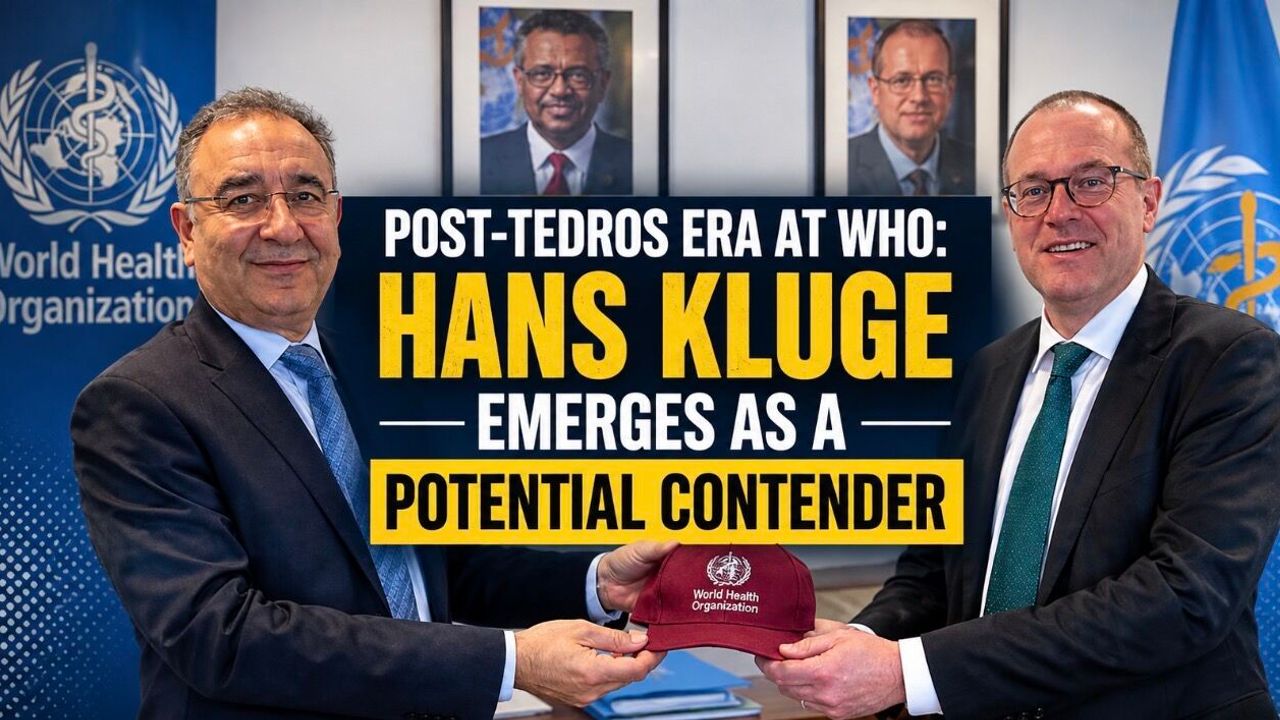
While the field of candidates has yet to be finalized, WHO Regional Director for Europe Dr Hans Kluge could emerge as a significant contender.
The World Health Organization’s 2027 Director-General election will determine far more than who occupies the organization’s top office for the next five years.
It may also help determine what kind of institution WHO will become at a time when the world faces an increasingly complex public health landscape.
Future pandemic threats, antimicrobial resistance, chronic diseases, climate-related health risks, humanitarian emergencies and widening health inequalities all demand strong international coordination.
At the same time, WHO itself is facing major challenges involving financing, institutional independence, workforce capacity and its ability to maintain scientific authority in an increasingly polarized geopolitical environment.
Against this backdrop, the May 2027 election could prove to be much more than a routine leadership transition.
From Margaret Chan to the Tedros Era
Following Hong Kong physician Dr Margaret Chan, Dr Tedros Adhanom Ghebreyesus, Ethiopia’s former Minister of Health and Minister of Foreign Affairs, was elected WHO Director-General in 2017.
His election marked the beginning of a very different period for the organization.
The COVID-19 pandemic demonstrated just how indispensable WHO can be during a global health emergency, but it also placed virtually every aspect of the organization’s performance under unprecedented scrutiny.
Its decisions, communication strategy, relations with member states and handling of the early stages of the pandemic became subjects of intense international debate.

Tedros was elected to a second term in 2022. His current mandate will end in August 2027.
WHO has since entered another difficult period.
Criticism surrounding the pandemic response, tensions with the United States and the US withdrawal process, growing financial pressures and changes in the organization’s workforce have all contributed to uncertainty about its future.
Another important issue is institutional memory.
As experienced scientists, public health experts and technical officials who have spent decades within WHO leave or retire, preserving the organization’s accumulated expertise becomes increasingly important.
At the same time, appointments to senior positions in international organizations are frequently scrutinized over the balance between professional merit, geographic representation and political considerations.
For WHO, protecting the strength of its scientific and technical identity will therefore be one of the central challenges facing its next leadership.
Financing Could Be One of the Next Director-General’s Biggest Challenges
WHO’s financial structure is likely to be among the most difficult issues awaiting the next Director-General.
For decades, the organization has relied not only on assessed contributions from member states but also heavily on voluntary funding, much of which is earmarked for specific programs.
The US withdrawal process has made concerns over financial sustainability even more pressing.
The next Director-General will therefore have to do more than oversee international health policy.
WHO’s new leader will need to strengthen the organization’s financial resilience, navigate relations between competing geopolitical blocs and reinforce confidence in the independence of its scientific decision-making.
This combination of science, diplomacy and institutional management could make the 2027 election fundamentally different from previous contests.
Why Could Hans Kluge Emerge as a Contender?
One of the figures who could attract attention in the 2027 race is Dr Hans Henri P. Kluge, WHO Regional Director for Europe.
A Belgian national and physician, Kluge began his career in family medicine after completing medical training and further studies in tropical medicine.
His subsequent career took him to some of the world’s most challenging environments.
He worked with Médecins Sans Frontières in countries including Liberia and Somalia and later became involved in public health programs addressing tuberculosis, HIV and malaria.
His career with WHO stretches back more than a quarter of a century.
Kluge became WHO Regional Director for Europe in 2020, taking office just as COVID-19 was developing into the greatest global health emergency in generations.
He was suddenly responsible for helping coordinate the health response across a WHO region encompassing 53 countries with widely differing political systems, economic conditions and health infrastructures.
In 2025, he began a second term as WHO Regional Director for Europe.
That combination of medical training, field experience, institutional knowledge and health diplomacy could make him an important figure if he enters the Director-General race.
Health Diplomacy Could Be Kluge’s Key Advantage
One of Kluge’s potential strengths is his experience working across political divides.
His career has involved extensive engagement across Western Europe, the Balkans, Russia, the Caucasus and Central Asia.
If nominated, Kluge could potentially seek support not only from European Union countries but also from the Balkans, the Caucasus, Central Asia and Turkic states.
His longstanding professional experience involving Russia and the wider post-Soviet region could also become an important factor in the electoral arithmetic.
Support from North America and some Pacific countries could further broaden the coalition behind a potential candidacy.
But an important distinction must be made.
Hans Kluge has not yet been officially declared a candidate for WHO Director-General, and there is currently no confirmed bloc of countries committed to supporting him.
Any assessment at this stage therefore concerns his potential candidacy, international profile and possible electoral advantages rather than confirmed voting intentions.
A Strong Latin American Candidate Could Change the Race
Professional credentials alone will not determine the outcome.
The election of a WHO Director-General is also a major exercise in international diplomacy.
Regional considerations, diplomatic alliances and relations between member states can all influence the contest.
After two consecutive terms under an African Director-General, there may be greater political space for candidates from other regions in 2027.
Latin America and the Caribbean could be particularly important.
If the region puts forward a prominent health leader with substantial international experience and diplomatic support, the dynamics of the election could change considerably.
Such a candidate might be able to build a coalition extending beyond Latin America to countries in Africa, the Middle East and Asia.
Kluge may therefore have the profile of a potentially strong contender, but it would be premature to describe the 2027 race as having a clear favorite.
September 24 Will Be a Critical Date
The formal process for electing the next WHO Director-General began on April 24, 2026.
Member states have until September 24, 2026 to submit nominations.
Once the nomination process is completed, the candidates will enter a period in which their backgrounds, priorities and visions for WHO’s future will come under international scrutiny.
The WHO Executive Board is expected to assess the candidates in January 2027 and nominate up to three candidates for consideration by the World Health Assembly.
The final decision will be made at the 80th World Health Assembly in May 2027, where member states will elect the next Director-General by secret ballot.
The successful candidate is expected to take office in August 2027.
The Real Question Is Bigger Than Hans Kluge
Ultimately, the significance of the 2027 election extends far beyond whether Hans Kluge or any other individual becomes Director-General.
The world needs an effective World Health Organization.
The next leader will inherit the difficult task of strengthening WHO’s financing, retaining highly qualified scientists and technical experts, improving preparedness for future health emergencies and protecting the organization’s scientific independence amid geopolitical competition.
Above all, WHO will need to reinforce the principle at the heart of its global mandate:
To serve as a trusted scientific and technical authority on global health, capable of working across political borders.
Kluge’s career, spanning clinical medicine, humanitarian settings, infectious disease programs, health systems and regional leadership, could give him a compelling profile if he decides to enter the race.
But the election of a WHO Director-General is never simply a competition between CVs.
Regional alliances, geopolitical interests, diplomatic relationships and the priorities of WHO’s member states will all converge in Geneva.
That means the central question in 2027 will not simply be:
“Who will succeed Tedros?”
The much bigger question will be:
Can the World Health Organization once again establish itself as a strong, trusted and independent global leader built on science, technical expertise and public health?
And if Hans Kluge enters the race, another question will inevitably follow:
Could Dr Hans Kluge be the leader capable of taking WHO back to its stronger and more prestigious days?